

Slept a full night but still not refreshed?
A full night's sleep can still leave you unrefreshed, because sleep quality matters as much as the number of hours. Most adults need about 7 to 9 hours a night, and sleep quality is judged by how long it takes to fall asleep, how often you wake and how much of your time in bed is actually spent asleep. The NIH links everyday habits, such as going to bed and waking up at the same time, avoiding caffeine late in the day and keeping the bedroom dark and quiet, to sleep.
Many of us focus on how many hours we sleep, but the quality of that sleep matters just as much.
Even after seven or eight hours in bed, if it takes a long time to fall asleep, you wake often during the night, or you don't feel properly rested when you get up, you may feel drained, find it hard to concentrate, and feel less ready for the day ahead.
Research now links sleep quality to a range of factors, including everyday stress, the balance of the nervous system, oxidative stress, and getting the right nutrients.
In short
- Hours: adults aged 18 to 64 should aim for 7 to 9 hours a night
- Quality: judged on four things: time to fall asleep, night-time awakenings, time awake after first falling asleep, and how much of your time in bed is spent asleep
- Deep sleep: the stage you need to feel refreshed in the morning, which comes in longer periods in the first half of the night
- The mind: stress and long hours on screens can keep the mind alert even at bedtime
- Everyday habits: a regular sleep schedule, no caffeine late in the day, and a dark, quiet bedroom
How is sleep quality judged?
The US National Sleep Foundation (NSF) says that getting enough hours of sleep doesn't necessarily mean you're getting the highest quality sleep. Sleep quality is one part of sleep health, along with sleep duration, sleep satisfaction and sleep consistency.
The NSF splits sleep quality into four elements, which were decided by an NSF-led expert group after reviewing 277 research studies and published as a consensus guideline in the journal Sleep Health in 2017:
- Sleep latency: how long it takes you to fall asleep
- Awakenings: how many times you wake during the night
- Wake after sleep onset: how long you are awake after first falling asleep
- Sleep efficiency: the ratio of time asleep to time lying in bed
Which questions help you look at your sleep quality?
All of these can be self-rated after a night's sleep. The NSF suggests the age-based questions below. If you answer "yes" to most of them, the NSF says you likely have good sleep quality.
| Question | Adults 18–64 | Older adults 65+ |
|---|---|---|
| How long did it take to fall asleep? | 30 minutes or less | 30 minutes or less |
| How many times did you wake during the night? | Once or less | Twice or less |
| After falling asleep, how long were you awake in total? | 20 minutes or less | 30 minutes or less |
| How much of your time in bed were you asleep? | Most of it, e.g. 7 out of 8 hours | Most of it, e.g. 7 out of 8 hours |
The NSF notes that the standard way to measure all four elements is an in-lab sleep test, while wearables and bedside devices capture some of the same data. The questions above are a rough guide.
How many hours of sleep do you need?
The NSF says there is no precise number of hours that guarantees you will wake up feeling totally refreshed, but depending on your age and lifestyle, what's recommended likely falls within these ranges.
| Age group | Recommended hours of sleep |
|---|---|
| School-age children 6–13 | 9–11 hours |
| Teenagers 14–17 | 8–10 hours |
| Adults 18–64 | 7–9 hours |
| Over 65 | 7–8 hours |
Everyday habits affect both how long and how well you sleep. For more on this, see Want to sleep better? Which habits can you change?.
What do your brain and body do while you sleep?
The NIH's National Institute of Neurological Disorders and Stroke (NINDS) explains that your brain and body stay remarkably active while you sleep. There are two basic types of sleep: non-REM sleep, which has three stages, and REM sleep. You cycle through them several times a night, with longer REM periods later in the night.
| Stage | What happens |
|---|---|
| Non-REM stage 1 | The changeover from waking to sleep. Light sleep; heartbeat, breathing and eye movements slow. Usually lasts several minutes |
| Non-REM stage 2 | Light sleep before deeper sleep. Body temperature drops. You spend more of each cycle in this stage than in any other |
| Non-REM stage 3 | Deep sleep, which you need to feel refreshed in the morning. Heartbeat and breathing are at their slowest, and it may be hard to wake you. Longer periods come in the first half of the night |
| REM | First occurs about 90 minutes after falling asleep. Eyes move rapidly, and most dreaming happens here |
What makes you sleepy, and what keeps you awake?
NINDS explains that adenosine, a chemical released by cells, helps make you feel sleepy, and that caffeine counteracts sleepiness by blocking adenosine. The hormone melatonin helps you feel sleepy when it gets dark. Light is perhaps the greatest influence on the sleep-wake cycle, and exposure to light can make it hard to fall asleep or to get back to sleep after waking in the night. Your sleep needs are also shaped by stress, your sleep environment, age, and what you eat and drink.
What happens to sleep when the mind can't switch off?
Work pressure, long hours in front of screens and a fast-paced life can keep both body and mind in an alert state, even when it's time to rest. If work thoughts keep you up, see Can't sleep because your mind won't stop thinking?.
One nutrient attracting interest for sleep quality is sesamin, a natural lignan found in sesame seeds that is associated with managing oxidative stress in the body.
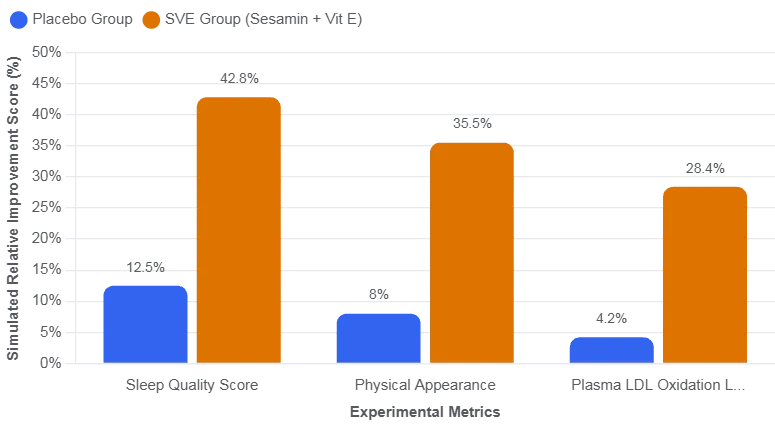
A study by Takemoto and colleagues (2015) looked at adults who felt tired in daily life and gave them sesame lignans (sesamin and episesamin) together with vitamin E for 8 weeks.
Reference: Takemoto, D., et al. (2015). Glob J Health Sci, 7(6), 1-10.
Among participants aged 40 and over, those who took sesame lignans with vitamin E consistently tended to see benefits in several areas:
- Better sleep quality
- Better scores for physical appearance related to fatigue
- Better markers of the body's antioxidant status
What are the limits of this study?
The study summary says that when all participants were analysed, there were no significant differences between the two groups; the differences from placebo were seen in a subgroup analysis of those aged 40 and over. The sleep scores came from questionnaires the participants filled in themselves, and the researchers worked for the company that makes the ingredient tested.
How does a relaxed body relate to good sleep?
Beyond the mind, the nervous system and muscles are another important part of how well we rest. NINDS explains that muscles relax progressively through the stages of sleep, and that during REM sleep the arm and leg muscles become temporarily paralysed.
Magnesium is a mineral that contributes to the normal function of muscles and the nervous system. Magnesium bisglycinate in particular, a form bound to the amino acid glycine, is popular because it is well absorbed and gentle on the digestive system.
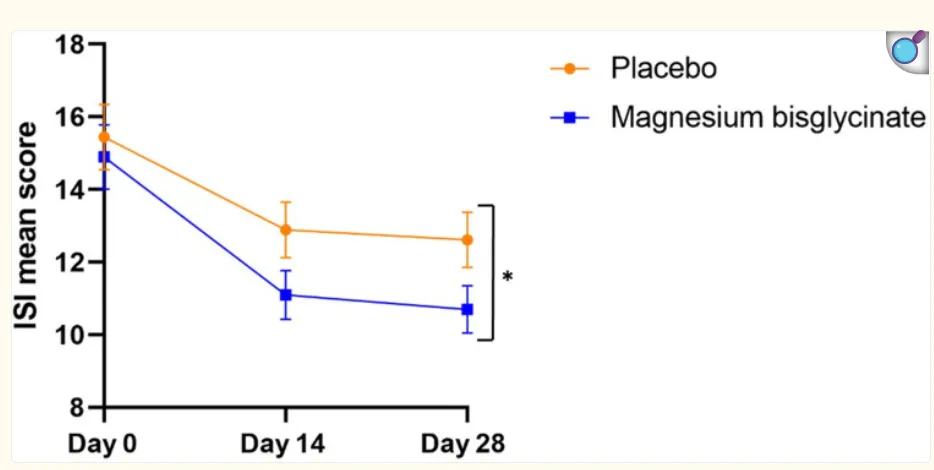
A randomized, double-blind, placebo-controlled trial in 155 adults with sleep complaints looked at magnesium bisglycinate providing 250 mg of magnesium a day for 28 days.
Reference: Schuster J, et al. Nat Sci Sleep. 2025;17:2027–2040.
After 28 days of magnesium bisglycinate, scores on a questionnaire that rates sleep problems (the ISI) fell by an average of 3.9 points, compared with 2.3 points in the placebo group, a statistically significant difference (p = 0.049).
What are the limits of this study?
The study by Schuster and colleagues was carried out in Germany, in adults who reported poor sleep quality themselves. ISI scores come from a questionnaire the participants filled in, the follow-up lasted only 4 weeks, and the researchers described the size of the difference between the groups as small.
Where does good sleep quality start?
- Mind relaxation: helps the body stay balanced against stress and oxidative stress → sesamin
- Body relaxation: supports the normal function of the nervous system and muscles → magnesium bisglycinate
Looking after both sides together, a relaxed mind and a balanced body, may be one way to support sleep quality, so your body gets the rest it needs and you can start each day feeling refreshed.
Which everyday habits are linked to sleep?
NINDS suggests these basic habits for sleep:
- Go to bed and wake up at the same time each day
- Exercise for at least 30 minutes most days of the week, but not within a few hours of bedtime
- Avoid caffeine and nicotine late in the day and alcoholic drinks before bed
- Relax before bed, for example with a warm bath or reading
- Keep the bedroom free of bright lights and loud sounds, at a comfortable temperature, and don't watch TV or use a smartphone in the bedroom
NINDS also advises seeing a doctor if you have problems sleeping or feel unusually tired during the day.
Good sleep isn't only about the number of hours. It comes from letting both mind and body relax, for quality rest every night.
If you are pregnant or breastfeeding, take regular medicines, or have a health condition under a doctor's care, talk to a doctor or pharmacist before taking dietary supplements.
Dietary supplements are not intended to prevent, treat or cure any disease.
Frequently asked questions
Why do I still feel tired after eight hours of sleep?
How can you tell if your sleep quality is good?
How many hours of sleep do adults need?
What is deep sleep?
How does coffee affect sleep?
What can I do to improve my sleep quality?
- Fu, L., Zhang, Y., Wang, Y., Huang, X., Chen, Y., & Liu, J. (2024). Effects of sesamin on sleep quality and the antioxidative status in patients with low arousal threshold obstructive sleep apnea syndrome and those at risk of obstructive sleep apnea syndrome. Journal of Functional Foods, 123, 106564.
- Schuster, J., Kisters, K., Lüneburg, N., Bloch, W., & Zimmer, P. (2025). Magnesium bisglycinate supplementation improves insomnia severity and sleep-related outcomes in adults with sleep complaints: A randomized, double-blind, placebo-controlled trial. Nature and Science of Sleep, 17, 2027-2040. ↗
- Takemoto, D., Yasutake, Y., Tomimori, N., Ono, Y., Shibata, H., & Hayashi, J. (2015). Sesame lignans and vitamin E supplementation improve subjective statuses and anti-oxidative capacity in healthy humans with feelings of daily fatigue. Global Journal of Health Science, 7(6), 1-10. ↗
- National Sleep Foundation: What is sleep quality? ↗
- National Sleep Foundation: How many hours of sleep do you really need? ↗
- Ohayon M, et al. National Sleep Foundation's sleep quality recommendations: first report. Sleep Health 2017 (PubMed) ↗
- National Institute of Neurological Disorders and Stroke (NIH): Brain Basics – Understanding Sleep ↗
- NIH Office of Dietary Supplements: Magnesium (Health Professional Fact Sheet) ↗
- Ministry of Public Health Notification No. 447 (B.E. 2566)
- Ministry of Public Health Notification No. 445 (B.E. 2566) on Nutrition Labelling – Thai RDIs (Annex 3)

We use cookies to improve performance and give you a better experience on this website. If you accept, we can show you content that better matches your interests. You can change your consent at any time via “Cookie settings”. Cookie policy